

The transition from traditional search engine results pages (SERPs) to generative search interfaces has necessitated a fundamental recalibration of search engine optimization strategies. By 2026, the industry has moved beyond simple keyword matching toward Generative Engine Optimization (GEO) and Answer Engine Optimization (AEO). Professional agencies and in-house SEO teams now require AI SEO tools that can navigate the complexities of Large Language Model (LLM) visibility, brand sentiment within AI summaries, and the automation of high-frequency technical tasks.
This article provides a detailed examination of 10 prominent SEO AI tools, evaluating their data accuracy, automation capabilities, and cost-efficiency for professional workflows. These AI tools for SEO reflect the current demand for platforms that provide multi-dimensional support, ranging from semantic content optimization to large-scale technical automation. As traditional search engines like Google incorporate AI Overviews and competitors like Perplexity and ChatGPT gain market share in the discovery phase, the ability to monitor brand citations across diverse AI platforms has become a non-negotiable requirement for digital marketers.
Comparative Analysis of 2026 AI SEO Platforms
The following table benchmarks the primary features, entry costs, and specialized capabilities of the leading best AI SEO tools evaluated in this analysis.
| Tool | Core Strength | 2026 AI Visibility Tracking | Starting Monthly Price (Annual) | Primary User Persona |
| SE Ranking | Modular Full-Suite Management | Yes (AI Overviews & LLMs) | $103.20 | Agencies & Professional SEOs |
| Ahrefs | Deep Data & Competitive Intelligence | Yes (Brand Radar) | $129.00 | Data Scientists & Search Specialists |
| Semrush | Market Intelligence & Content Suite | Yes (AI Visibility Toolkit) | $165.17 | Enterprises & Multi-Channel Teams |
| Clearscope | Enterprise Semantic Content Scoring | Partial (Inventory Analysis) | $129.00 | Quality-First Editorial Teams |
| Frase | Research & AI Brief Generation | Yes (GEO Scoring) | $15.00 | Freelance Writers & Content Agencies |
| Jasper | Scalable AI Writing & Brand Voice | No (External Integration) | $49.00 | Marketing Teams & CMOs |
| Alli AI | Technical SEO Automation & Deployment | Yes (Visibility Engine) | $249.00 | Large Domain Operators |
| Search Atlas | Agentic Research & Agency Workflows | Yes (OTTO SEO Assistant) | $99.00 | Performance Agencies |
| NeuronWriter | Budget-Friendly NLP Optimization | Yes (AI Score for GEO) | $23.00 | SMBs & Strategic Content Teams |
| Surfer SEO | NLP-Based Content Optimization | Yes (AI Tracker) | $119.00 | Content Strategists & Editors |
1. SE Ranking
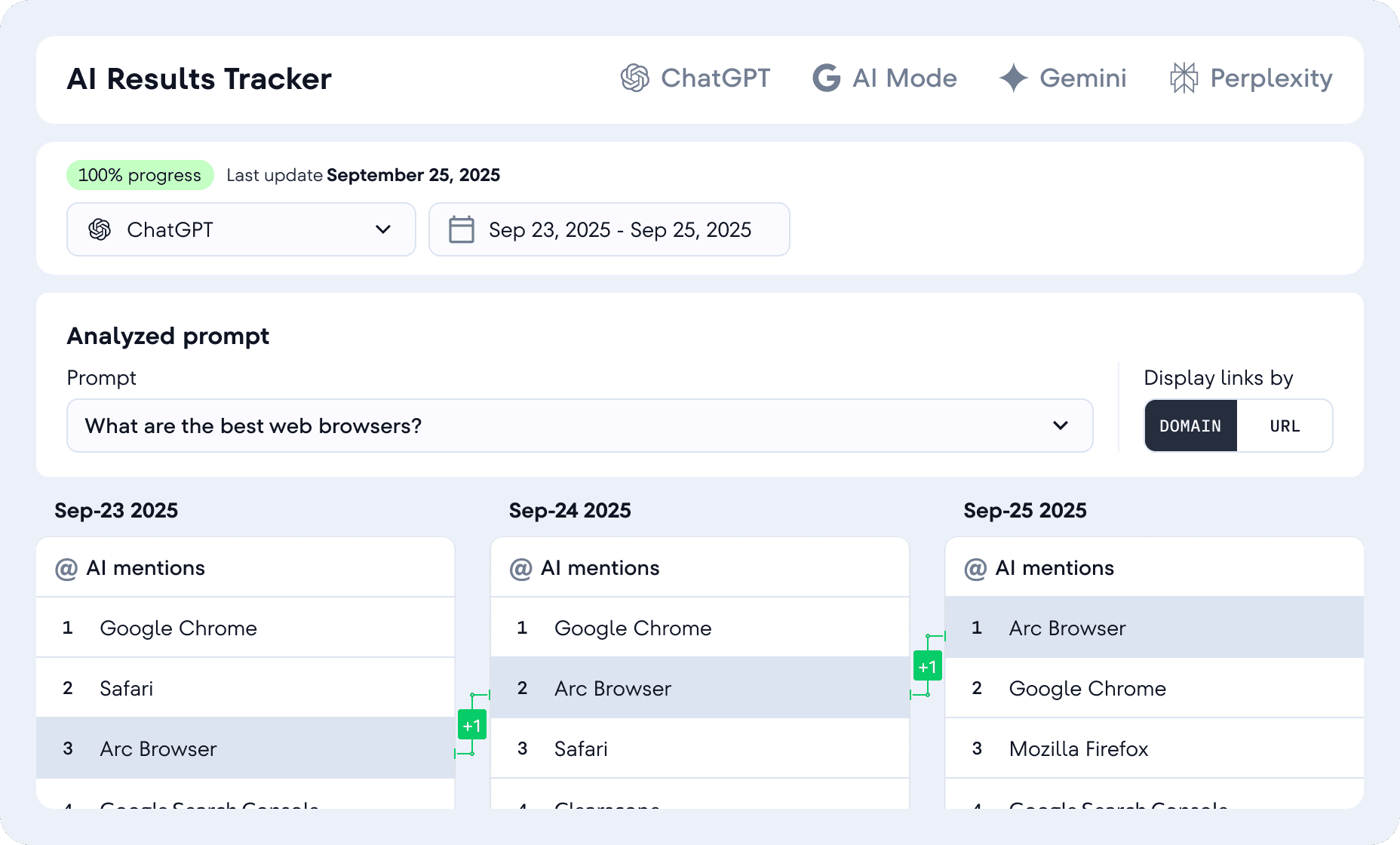
SE Ranking operates as a comprehensive AI SEO tools suite designed for agencies and in-house professionals who require high-precision data and scalable automation. The platform maintains a keyword database of 5.4 billion entries and a backlink index of 2.7 trillion, providing a robust empirical foundation for competitive analysis. By 2026, the platform will have integrated advanced AI search tracking modules that monitor brand visibility across six major AI platforms, including ChatGPT, Perplexity, and Google AI Overviews.
The architecture of SE Ranking prioritizes modularity, allowing users to select specific add-ons, such as the Content Marketing or Local Marketing modules, based on their current project requirements. This prevents the pricing bloat often seen in enterprise-level tools while providing 90% of the functionality found in more expensive competitors.
The Technical Website Audit 2.0 executes over 115 specific checks to identify crawling bottlenecks and security risks. It ensures that site infrastructure remains optimal for both traditional search bots and modern AI crawlers.
Pros of SE Ranking
- Exceptional Price-to-Feature Ratio: The platform provides enterprise-grade data and AI tracking at 40-60% lower cost than Semrush or Ahrefs.
- Global Rank Tracking Accuracy: Position monitoring covers 188 countries, which exceeds the geographic reach of many premium alternatives.
- Integrated AI Visibility: The platform tracks mentions and sentiment within AI-generated responses across multiple LLM platforms, facilitating modern AEO reporting.
- Automated White-Label Reporting: Agencies can generate customized, branded reports and configure client access through the Agency Pack add-on.
- High-Volume Technical Audits: The site audit module processes up to 100,000 pages on mid-tier plans, identifying broken links, slow loading times, and core web vital failures.
Cons of SE Ranking
- Interface Complexity: The high density of modules and data visualization options requires a learning phase for new users or junior staff.
- Manual Content Finalization: While the AI Writer drafts content, the output necessitates human oversight to maintain brand voice and factual precision.
Key Features of SE Ranking
- AI Overview Tracker: This feature detects and monitors the presence of a domain within Google’s AI-generated search summaries, providing visibility metrics that traditional rank trackers exclude.
- SE Visible (AI Brand Visibility): The module calculates an AI Search Score by analyzing how often a brand is mentioned, cited, and positively perceived across conversational AI platforms.
- Content Marketing Module: Leveraging NLP and SERP analysis, this tool generates content briefs, suggests thematic keyword clusters, and scores articles in real time for SEO effectiveness.
- Predictive Traffic Forecasting: The system uses historical ranking data and market trends to project future organic traffic, aiding in strategic planning and budget allocation.
- Local Marketing Module: A specialized tool that manages directory citations, reviews, and local rankings in a grid visualization format for Google Business Profiles.
- Model Context Protocol (MCP) Integration: Enables seamless data exchange between the SEO platform and external AI assistants for custom workflow automation.
Pricing Plans of SE Ranking
SE Ranking utilizes a tiered subscription model with significant discounts (20%) for annual commitments.
- Core: $103.20/month with an annual 20% subscription.
- Growth: $233.20/month with an annual 20% subscription.
- AI-search add-on from $71.20/month (depending on the number of prompts).
- 14-day free trial available.
Optional add-ons include the Content Marketing tool ($23.20/month annually for 15 articles) and the Agency Pack ($50.00/month) for white-labeling and unlimited reporting.
Final Verdict of SE Ranking
SE Ranking remains a top AI SEO tool choice for professionals who require a data-rich, all-in-one platform without the premium overhead of enterprise legacy tools. It is particularly effective for agencies that need to prove value through comprehensive white-label reports and modern AI visibility metrics. While the content generation tools require manual refinement, the technical audit and rank tracking modules are among the most reliable in the 2026 market.
2. Ahrefs
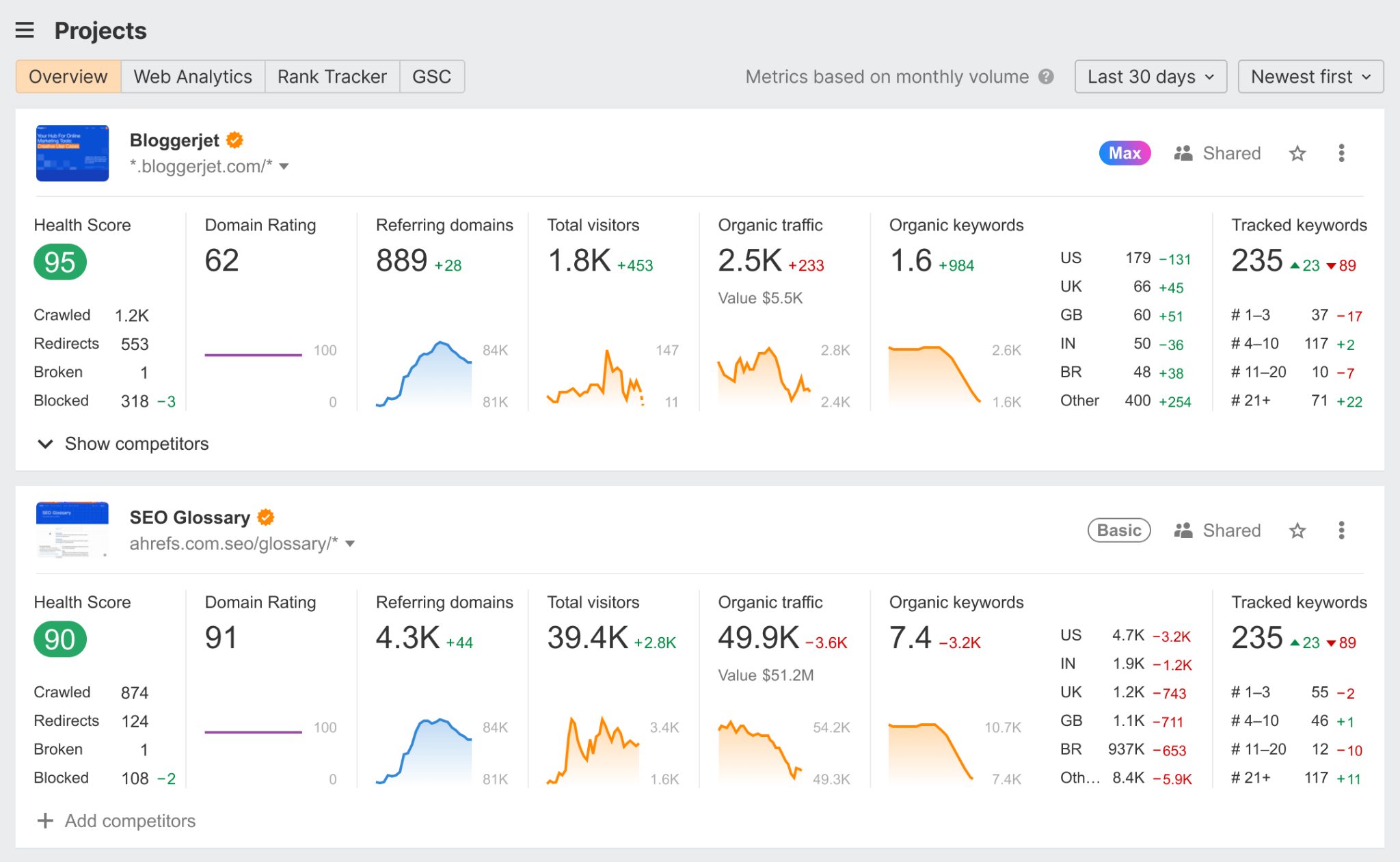
Ahrefs continues to be a primary repository for competitive intelligence and search data, maintaining a 15-year historical archive and a keyword database of 110 billion terms. By 2026, the platform has launched Brand Radar, a specialized AI visibility monitoring system that tracks brand presence across 240 million monthly prompts. These prompts derive from real People Also Ask data, ensuring that the tool analyzes actual human search behavior rather than synthetic queries.
The platform integrates AI throughout its core modules, including a Keywords Explorer that detects search intents and an AI Content Helper that identifies content gaps. Ahrefs positions itself as a data-first platform, prioritizing the accuracy of its backlink index and traffic estimations over the rapid generation of content. For technical SEOs, the Patches feature enables the automated fixing of meta tags, reducing the reliance on developer intervention for routine on-page optimizations.
Pros of Ahrefs
- Unrivaled Data Depth: The backlink and keyword databases deliver the most accurate difficulty scores and competitor insights available in the AI SEO optimization tools market.
- Brand Radar Precision: Monitors six major AI indexes, including Perplexity, ChatGPT, and Copilot, along with YouTube transcripts and TikTok descriptions.
- Predictive AI Analysis: The platform calculates AI Share of Voice by weighting mentions against Google search volume, providing a realistic view of brand reach.
- Automated Technical SEO: The Patches module auto-fixes title tags and meta descriptions across large sites, streamlining the technical optimization process.
- Multilingual Localization: AI-powered translations localize keyword lists into 40+ languages while preserving search volume and traffic potential metrics.
Cons of Ahrefs
- Prohibitive Entry Cost: Base subscriptions are significantly higher than those of many competitors, and advanced AI features often require expensive monthly add-ons.
- Credit-Based Limitations: The usage model can restrict high-volume research or site audits, making it less scalable for teams on tight budgets.
- Complex User Experience: The data-heavy interface requires specialized training for users to extract actionable insights efficiently.
Key Features of Ahrefs
- Brand Radar: A visibility engine that tracks citations and mentions across LLMs, weighted by real-world search demand.
- AI Content Helper: A tool that color-codes sentences to predict which segments of content AI search engines are most likely to surface.
- AI Search Intents: Analyzes keywords to determine the percentage of traffic belonging to informational, navigational, or transactional intents.
- Technical SEO Patches: Leverages AI to detect and automatically implement metadata fixes without requiring developer resources.
- AI Detector: Integrated into the site audit module to evaluate the percentage of AI-generated content on a domain, aiding in quality control.
Pricing Plans of Ahrefs
Ahrefs pricing in 2026 involves a base fee plus specialized add-on kits:
- Lite Plan: Starts at $129/month.
- Standard Plan: $249/month.
- Advanced Plan: $449/month.
- AI Content Helper Add-on: $99/month, or $299/month for the full Content Kit (250 documents).
- Brand Radar Standalone: Tiers range from $50.00 (2,500 prompts) to $250.00 (25,000 prompts).
- AI Index Bundle: Access to all six AI platform indexes for $699.00/month.
Final Verdict of Ahrefs
Ahrefs is the best AI SEO tools choice for data scientists and senior SEO specialists who require empirical precision and competitive depth. Its Brand Radar provides the industry’s most granular view of how AI systems interpret a brand’s authority. However, the total cost of ownership makes it more suitable for large enterprises and high-revenue agencies than for small business operators.
3. Semrush
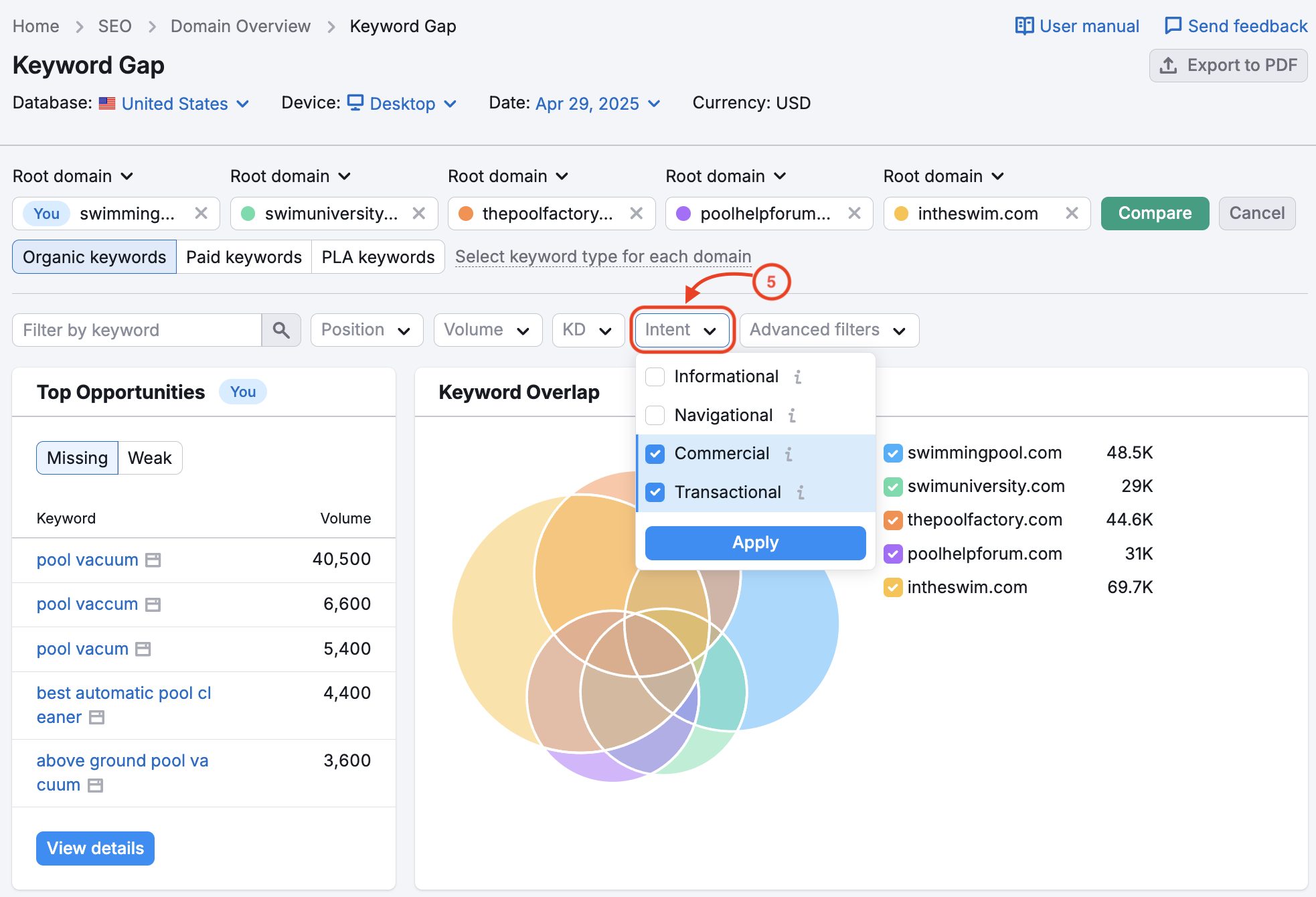
Semrush has evolved into a predictive intelligence platform with the launch of Semrush One, a unified subscription that merges traditional SEO tools with a dedicated AI Visibility Toolkit. The platform manages a keyword database of 26.8 billion terms and serves as a comprehensive AI-powered SEO tools ecosystem for digital marketing. By 2026, the Semrush Copilot will act as an automated assistant, analyzing domain data to identify technical issues, ranking drops, and competitor opportunities in real-time.
The platform’s AI Visibility Toolkit addresses the fundamental shift toward conversational discovery by tracking brand mentions across Gemini, ChatGPT, Perplexity, and Google AI Overviews. This toolkit provides sentiment analysis and citation source tracking, allowing brands to see which of their pages AI assistants reference most frequently. Additionally, Semrush offers ContentShake AI to automate the creation of social posts and SEO-optimized articles that are formatted for both human readers and AI crawlers.
Pros of Semrush
- All-in-One Ecosystem: Consolidates keyword research, backlink analysis, site audits, and AI visibility into a single, integrated interface.
- Proactive Insights: Semrush Copilot prioritizes recommendations based on their potential impact, reducing the time spent on manual data analysis.
- Enterprise Segmentation: Large organizations can filter AI visibility data by region, persona, or product line for granular reporting.
- Comprehensive Market Intelligence: The Trends add-on provides deep insights into market share and competitor traffic patterns.
- Historical Data Access: Mid-tier plans and higher provide access to years of ranking history, facilitating long-term trend analysis.
Cons of Semrush
- Restrictive User Limits: Basic plans include only one user seat; adding team members can cost between $45.00 and $100.00 per person per month.
- Steep Learning Curve: The vast number of tools (over 50) and reports can be overwhelming for beginners or non-SEO staff.
- High Cumulative Costs: Specialized toolkits for local SEO, market analysis, and AI visibility often carry additional monthly fees.
Key Features of Semrush
- AI Visibility Toolkit: Measures Visibility Scores across multiple LLMs and identifies queries where competitors are mentioned but the user’s brand is not.
- Semrush Copilot: An AI dashboard assistant that uses natural language to provide automated insights and explain ranking fluctuations.
- AI Search Sentiment Analysis: Evaluates the context of brand mentions across AI platforms to identify positive or negative narratives.
- ContentShake AI: An automated writing tool that generates content optimized for both search engines and generative answer engines.
- AI PR Toolkit: Analyzes brand placements and mentions across the web to identify new outreach and citation opportunities.
Pricing Plans of Semrush
Semrush One offers three tiers with significant annual discounts (17%).
- Starter Plan: $165.17/month (annual). Covers 5 projects and 500 keywords.
- Pro+ Plan: $248.17/month (annual). Covers 15 projects, 1,500 keywords, and includes historical data.
- Advanced Plan: $455.67/month (annual). Enterprise-grade with 40 projects and 5,000 keywords.
- AI Visibility Toolkit Add-on: Available separately for $99.00/month per domain.
Final Verdict of Semrush
Semrush remains a top SEO AI tool choice for enterprises that require a unified command center for their digital marketing. Its AI Visibility Toolkit is particularly effective for teams needing to bridge the gap between traditional SEO and conversational search. While the cost for multi-user teams is high, the consolidation of disparate functions into one platform often provides a superior return on investment for large-scale operations.
4. Clearscope
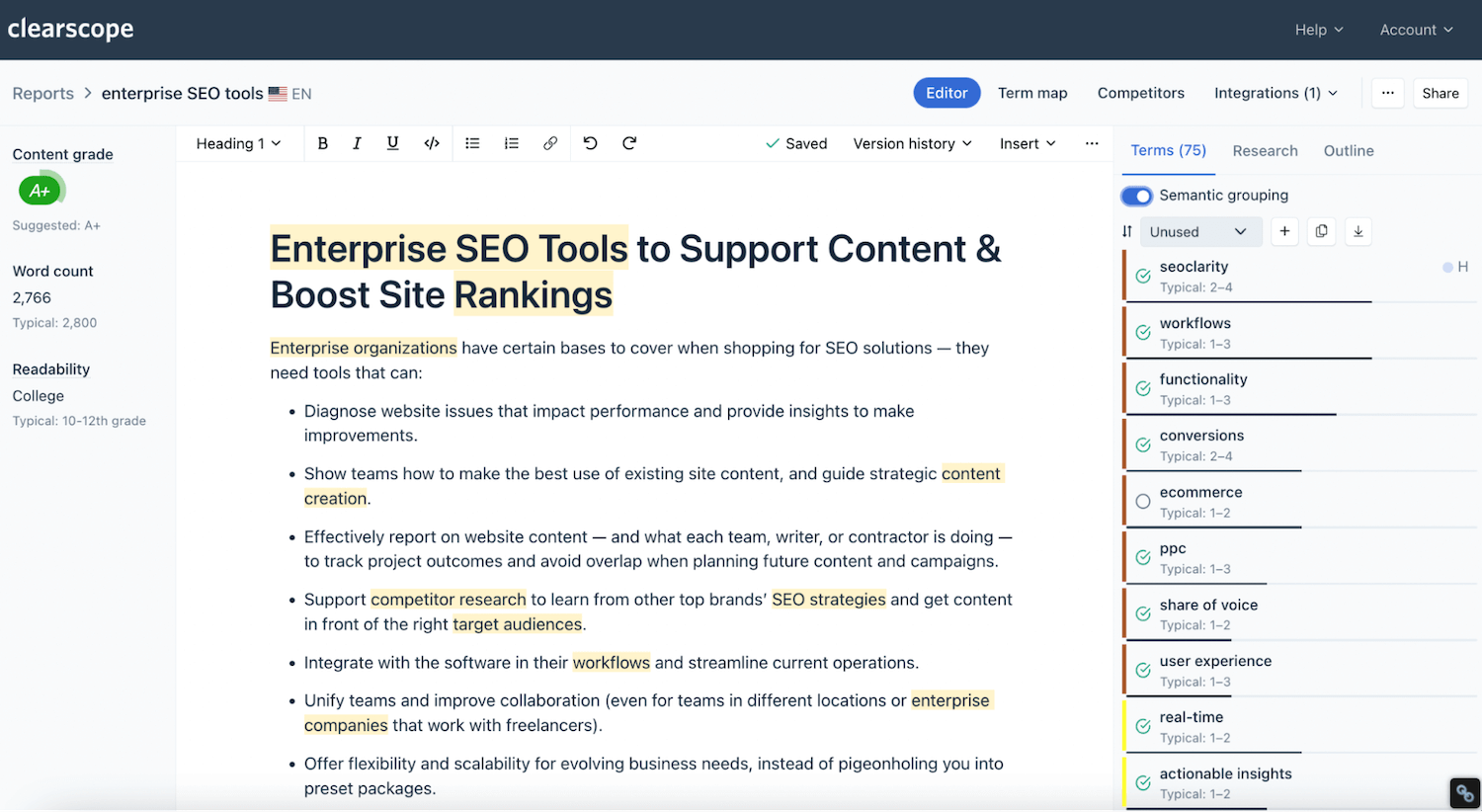
Clearscope is an enterprise-grade AI-Powered SEO tools platform designed for high-authority editorial teams. It prioritizes Information Density and semantic depth, using advanced topic modeling to identify the entities that search engines and AI systems associate with high-quality content. Unlike many budget tools, Clearscope focuses on context and comprehensiveness, assigning articles a letter grade (A+ to F) based on how well they cover necessary subtopics.
The platform is engineered to integrate into existing professional workflows, offering seamless plugins for Google Docs and WordPress. Its 2026 features include Content Health Reports, which monitor a domain’s content inventory and alert teams when a page’s relevance drops due to shifts in competitor strategies or search intent. Clearscope is often the preferred tool for organizations that prioritize quality and authority over raw content volume.
Pros of Clearscope
- Superior Semantic Analysis: Widely considered the most accurate tool for identifying the semantic terms needed to rank for competitive keywords.
- Unlimited User Seats: Many plans include unlimited users, making it a cost-effective choice for large internal marketing teams.
- Minimalist Interface: The clean, distraction-free editor keeps writers focused on content quality rather than technical SEO metrics.
- Inventory Health Tracking: Automatically monitors the ranking potential of an entire content library and identifies pages in need of updates.
- High Trust Factor: Used by major enterprise brands to maintain editorial standards across thousands of articles.
Cons of Clearscope
- High Entry Price: The starting cost is significantly higher than most AI tools for SEO, limiting its accessibility for small businesses.
- Lack of Content Generation: The tool provides optimization guidelines, but does not include a native AI writer to generate drafts.
- No Technical SEO Tools: Does not offer rank tracking, backlink analysis, or site audit capabilities.
Key Features of Clearscope
- Content Grading: Uses semantic models to assign a letter grade based on topical comprehensiveness compared to top competitors.
- Topic Modeling: Identifies the broad themes and specific questions (from People Also Ask) that content must address to build authority.
- Content Inventory: A management system that tracks the SEO health of all published pages on a domain.
- Keyword Discovery: Surfaces high-value secondary keywords that are semantically linked to the primary search term.
Pricing Plans of Clearscope
Clearscope follows a simplified, high-tier pricing structure for 2026:
- Essentials Plan: $129/month.
- Business Plan: $399/month.
- Enterprise Plan: Custom pricing for large organizations requiring custom integrations and security.
Final Verdict of Clearscope
Clearscope is the premier AI tool for website SEO for large-scale editorial operations and enterprise brands. It is designed for teams that view content as a high-value strategic asset and need to maintain the highest possible standards of authority and relevance. While expensive, its precision in semantic optimization is a major driver of long-term organic traffic for competitive niches.
5. Frase
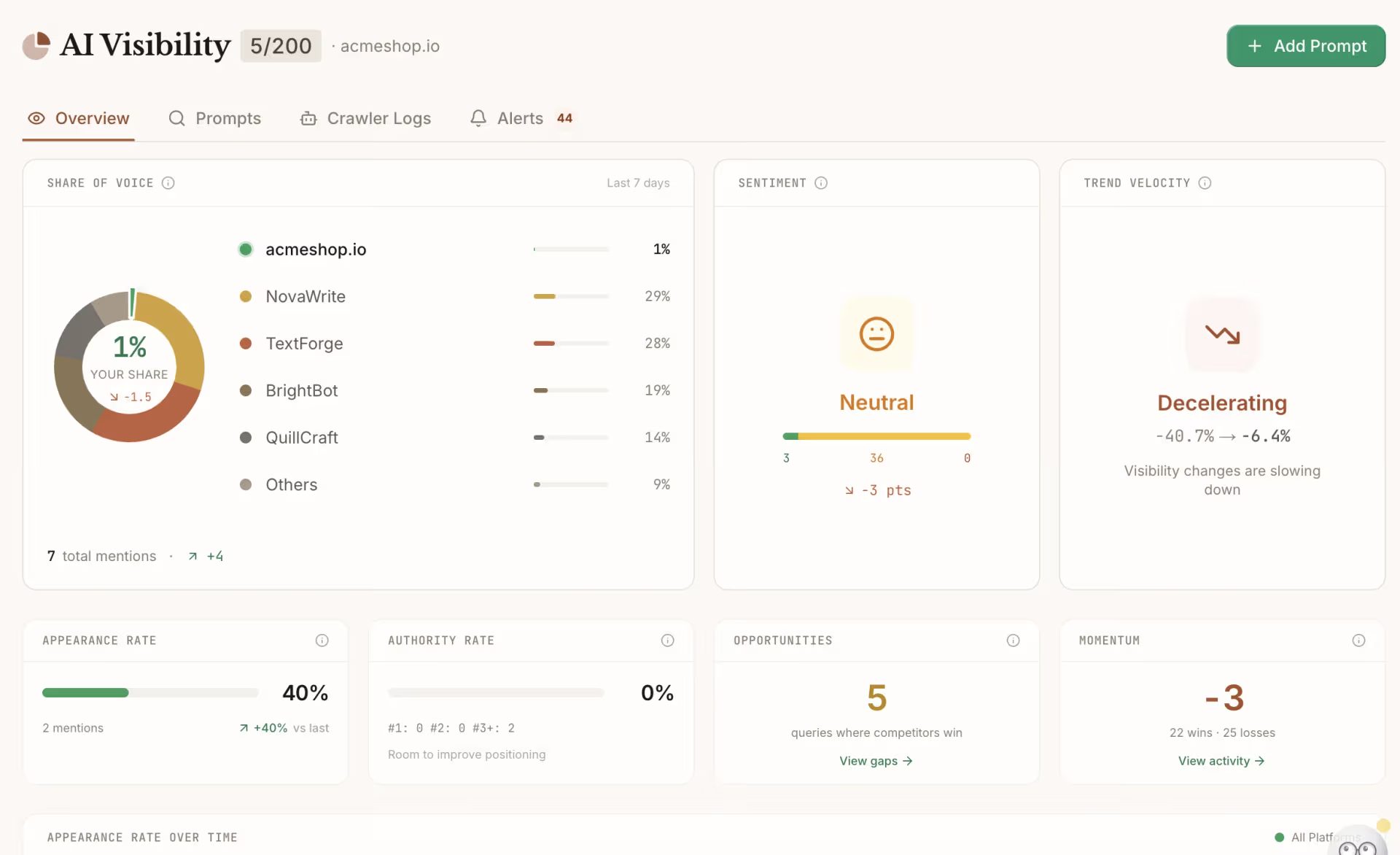
Frase is an SEO AI tools platform that bridges the gap between research and content production. It specializes in analyzing the top 20 search results for a keyword and automatically generating a detailed Content Brief that includes common headers, statistics, and subtopics. By 2026, Frase has integrated GEO scoring (Generative Engine Optimization), which evaluates how well an article aligns with the data preferences of AI assistants like ChatGPT and Perplexity.
The tool includes a built-in AI writing assistant that can draft outlines, intros, and full sections based on the SERP data gathered during the research phase. Frase is particularly valuable for agencies and content managers who need to produce high volumes of briefs for freelance writers while ensuring that all content is optimized for both traditional SERPs and generative search summaries.
Pros of Frase
- Efficiency in Research: Automates the manual task of scraping the SERP for topics, reducing brief-creation time from hours to minutes.
- Low Entry Cost: Offers one of the most affordable starting prices for professional-grade ai seo tools.
- Question Research: Pulls directly from People Also Ask and Reddit to identify the specific queries users are searching for in real-time.
- GEO Optimization: The dual SEO + GEO scoring helps writers target both Google’s blue links and AI answer engines simultaneously.
- Team Collaboration: Includes features for sharing briefs and tracking the status of content projects within the dashboard.
Cons of Frase
- Less Precise Scoring: Some users find its content optimization score to be slightly less nuanced than those of Clearscope or Surfer SEO.
- Standard Research Depth: The analysis is primarily based on current Google results, which may miss emerging trends in niche LLM datasets.
- No Technical Suite: Lacks the technical audit and backlink data required for a complete SEO strategy.
Key Features of Frase
- AI Content Briefs: Automatically constructs comprehensive outlines based on the headers and topics used by top-ranking competitors.
- SERP Analysis: Summarizes the top search results for any keyword, providing data on word count, topic frequency, and domain authority.
- Question Discovery: Aggregates intent-driven queries from Google, Quora, and Reddit to help users address specific user needs.
- AI Writing Assistant: A tool for rephrasing, expanding, and drafting content using data pulled directly from the competitive research phase.
Pricing Plans of Frase
Frase offers several tiers to accommodate solo users and agencies for 2026:
- Starter Plan: $49/month.
- Professional Plan: $129/month.
- Scale Plan: $299/month.
Final Verdict of Frase
Frase is the best free AI tools for SEO for professionals who need powerful research and brief-generation capabilities without the enterprise price tag. It is an exceptional tool for content managers who need to maintain a high publishing cadence across multiple clients. Its introduction of GEO scoring makes it a forward-looking choice for agencies preparing for a generative-first search landscape.
6. Jasper
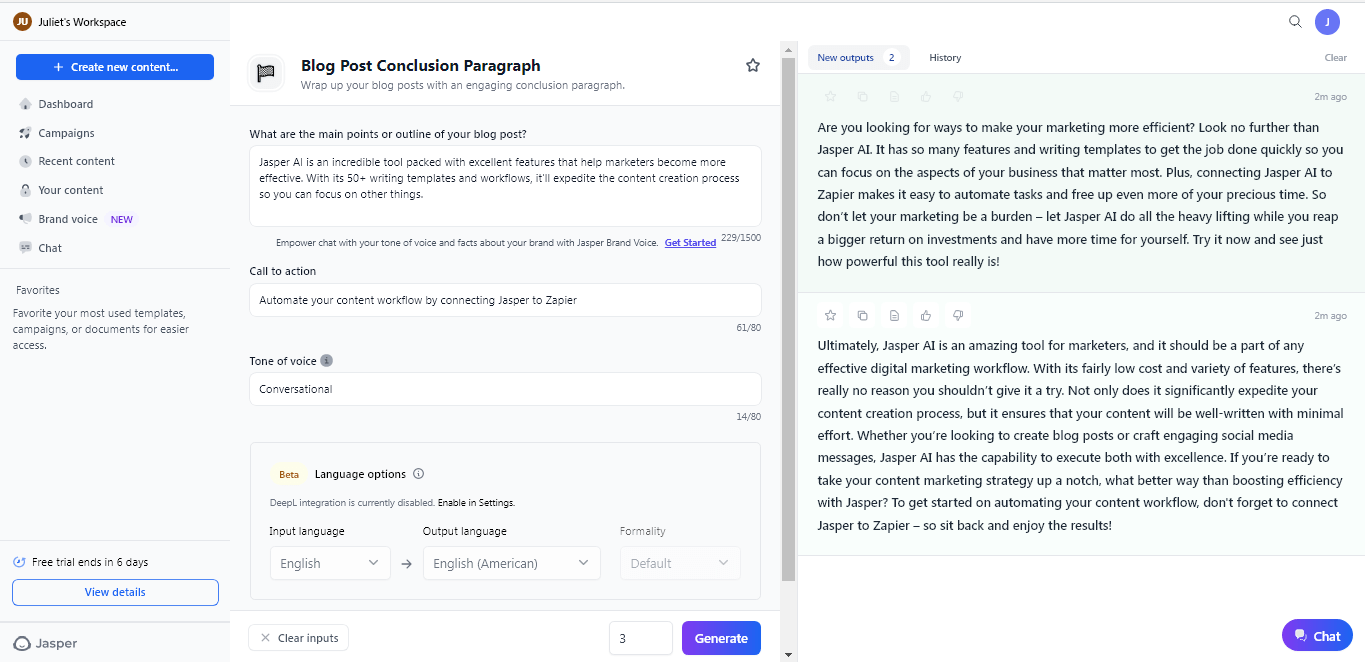
Jasper is a high-volume AI-powered SEO tools writing assistant designed for large-scale marketing campaigns. Unlike generic chatbots, Jasper can be trained on a specific Brand Voice, ensuring that all generated content adheres to a company’s unique tone, style, and product terminology. By 2026, it has become a central hub for marketing teams that need to produce blog posts, social media updates, and email sequences while maintaining consistency.
While Jasper focuses on generation, its deep integration with Surfer SEO allows users to optimize their articles for search visibility as they are being written. It is frequently used by CMOs and agency owners who need to scale their content output without exponentially increasing their headcount. Jasper emphasizes Marketing Automation, providing pre-built templates for dozens of common tasks.
Pros of Jasper
- Consistent Brand Voice: Prevents the generic AI tone by training on your specific company assets and style guides.
- Production Speed: Capable of generating full-length articles, social captions, and ad copy in seconds from simple prompts.
- Pre-built Templates: Includes over 50 recipes for specific tasks like blog introductions, meta descriptions, and product feature lists.
- Multilingual Generation: Supports content creation in over 25 languages while preserving the trained brand voice.
- Collaboration Features: Provides shared workspaces and approval workflows for large marketing departments.
Cons of Jasper
- No Native SEO Data: Requires an external tool (like Surfer SEO) to provide the keywords and structural data needed for optimization.
- Per-Seat Pricing: The cost can scale quickly for large teams, as most plans are priced per user seat.
- Variable Factual Accuracy: AI-generated drafts still require human fact-checking to ensure all claims and data points are correct.
Key Features of Jasper
- Brand Kit: A centralized repository where users can upload style guides and company information to train the AI.
- Surfer SEO Integration: Displays a real-time SEO score and keyword checklist directly within the Jasper writing interface.
- One-Click Article Generator: Produces a full-length draft from a single topic prompt, structured for immediate optimization.
- Team Workspaces: Collaborative environments where multiple users can edit and comment on the same document.
Pricing Plans of Jasper
Jasper 2026 pricing reflects its professional and corporate focus:
- Pro Plan: $69/month.
- Business Plan: custom pricing for enterprise-wide deployments.
Final Verdict of Jasper
Jasper is the top SEO AI tools choice for teams that prioritize scale and brand identity. It is not an all-in-one SEO platform, but as a content production engine, it is unmatched in its ability to produce consistent, high-quality drafts for a variety of marketing channels. When paired with an optimization tool like Surfer, it becomes a powerful system for maintaining topical authority at volume.
7. Alli AI
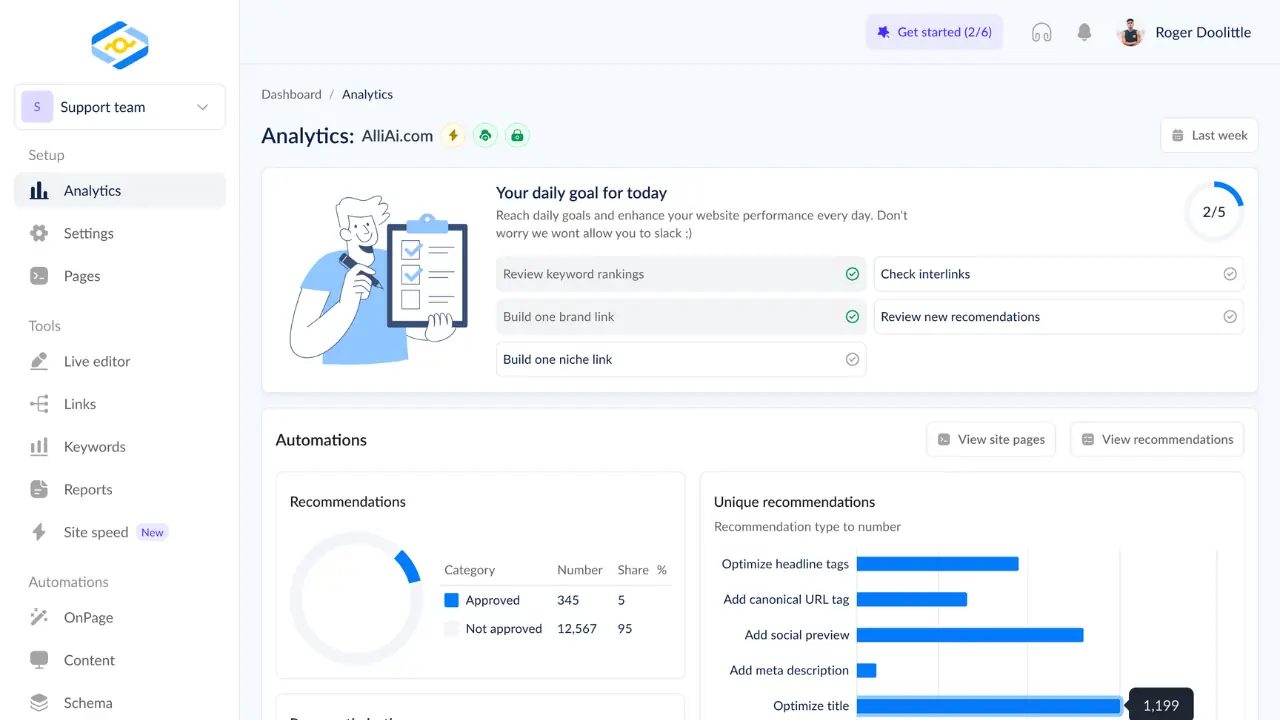
Alli AI is a Zero-Dev AI-based SEO tool that automates technical on-page optimizations via a JavaScript snippet. Instead of producing a list of technical recommendations that a developer must implement, Alli AI allows the SEO specialist to approve changes within a dashboard and deploy them instantly to the live site. This is a game-changer for large enterprise sites and agencies where technical implementation backlogs can stall SEO growth for months.
By 2026, the tool has introduced a Search Visibility Engine to ensure that site infrastructures are readable by AI crawlers from ChatGPT and Perplexity. The platform handles high-frequency tasks such as schema markup generation, internal link optimization, and bulk meta tag updates. For agencies managing dozens of clients on different CMS platforms, Alli AI serves as an automated SEO director that eliminates technical bottlenecks.
Pros of Alli AI
- Instant Technical Deployment: Can update 10,000+ pages in under 60 seconds once the changes are approved.
- CMS Compatibility: Works on any platform—including WordPress, Shopify, and legacy systems—through a single JS integration.
- SEO A/B Testing: Enables teams to test different titles or content variations and automatically deploy the version that drives more traffic.
- Internal Link Automation: Analyzes site content to suggest and implement relevant internal links with optimized anchor text.
- Scalable Schema: Automatically generates and deploys JSON-LD schema for products, reviews, and FAQs.
Cons of Alli AI
- Lock-in Effect: All optimizations are immediately reversed if the subscription is canceled, creating a long-term dependency.
- High Unit Cost: The starting price for a single site is much higher than traditional SEO suites.
- JavaScript Reliance: While search engines index JS well, some edge cases may experience minor page speed impacts.
Key Features of Alli AI
- Live Editor: A visual tool that allows users to make SEO changes directly on their website pages without editing code.
- AI Search Visibility Engine: A module specifically designed to make websites discoverable and readable for modern AI chatbots.
- Bulk On-Page Optimization: A system for updating title tags, H1s, and meta descriptions across entire domains simultaneously.
- Site Speed Optimizer: Automates common technical fixes to improve Core Web Vitals and loading times.
Pricing Plans of Alli AI
Alli AI pricing scales based on the number of sites and tracked keywords:
- Business Plan: $249/month (annual). Covers 5 sites and 500 keywords.
- Agency Plan: $499/month (annual). Covers 15 sites and 2,000 keywords.
- Enterprise Plan: Starts at $1,249/month for up to 50 sites and 5,000 keywords.
Final Verdict of Alli AI
Alli AI is the best AI tools for SEO for agencies managing massive client portfolios and enterprises with heavy technical debt. It is a specialized implementation engine that converts SEO insights into live site changes instantly. While the subscription lock-in is a serious consideration, the labor savings for large sites often provide an immediate and substantial ROI.
8. Search Atlas (OTTO)
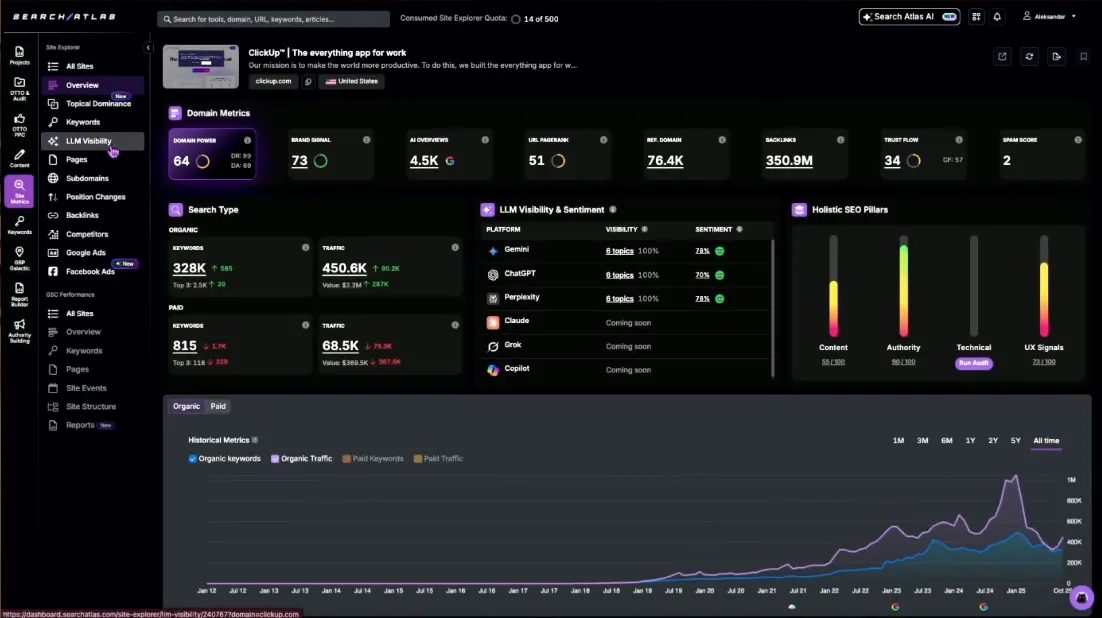
Search Atlas, featuring its OTTO SEO assistant, is a comprehensive AI SEO tools platform designed for high-level agency automation. It prioritizes Full-Cycle Autonomous Organic Dominance, attempting to automate everything from keyword clustering to content deployment and rank tracking. In 2026, it is recognized for its agentic research loops, which perform 8-minute deep dives into niche topics to uncover semantic authority gaps that simpler tools miss.
The platform is built with an agency-first workflow, offering white-label reporting, Looker Studio integrations, and multi-market visibility analysis. OTTO acts as an autonomous SEO agent that identifies optimization opportunities across a domain and executes them to build entity authority. By 2026, Search Atlas has also integrated AI Overview Optimization to help brands gain visibility in Google’s generative results.
Pros of Search Atlas (OTTO)
- Autonomous Agentic Research: Performs multi-step research to identify nuances in search intent and competitive content gaps.
- Advanced Agency Workflow: Provides the most comprehensive set of white-label reporting and client management tools for agencies.
- Content Cluster Automation: Automatically generates and deploys interconnected topic clusters to build topical authority.
- Competitive AI Benchmarking: Offers real-time monitoring of rival brand mentions across ChatGPT, Gemini, and Perplexity.
- Entity Authority Building: Focuses on structuring content for 2026 GEO requirements, ensuring high machine-readability.
Cons of Search Atlas (OTTO)
- Steep Entry for Automation: Many of the most powerful autonomous features are locked behind the mid-tier Growth plan.
- Complex Onboarding: Setting up the full autonomous workflow can take significant time for smaller agencies.
- Higher Cost for Solo Users: The price point is less competitive for individual site owners who don’t need the agency-scale features.
Key Features of Search Atlas (OTTO)
- OTTO SEO AI Assistant: An autonomous agent that identifies, prioritizes, and executes on-page optimizations.
- 8-Minute Agentic Loop: A deep research module that analyzes sitemaps and competitor entities to find unique content opportunities.
- AI Overview Optimization: A specialized tool for increasing the probability of being cited in Google’s AI-generated summaries.
- White-Label Reporting: High-quality, customizable reporting dashboards for client communication.
Pricing Plans of Search Atlas (OTTO)
Search Atlas offers tiered subscriptions tailored for different business scales:
- Starter Plan: $99/month.
- Growth Plan: $199/month. Includes the full OTTO automation suite.
- Pro Plan: $399/month.
- Agency Plan: $999/month.
- Enterprise Plan: Custom pricing for large agencies requiring API access and custom integrations.
Final Verdict of Search Atlas (OTTO)
Search Atlas is a top-tier AI SEO tool choice for performance agencies that want to scale their operations without significantly increasing headcount. Its agentic approach to SEO makes it one of the most future-proof platforms in the 2026 search market. While the cost is higher than basic suites, its ability to automate the entire SEO lifecycle provides a massive competitive advantage for agencies managing large client portfolios.
9. NeuronWriter
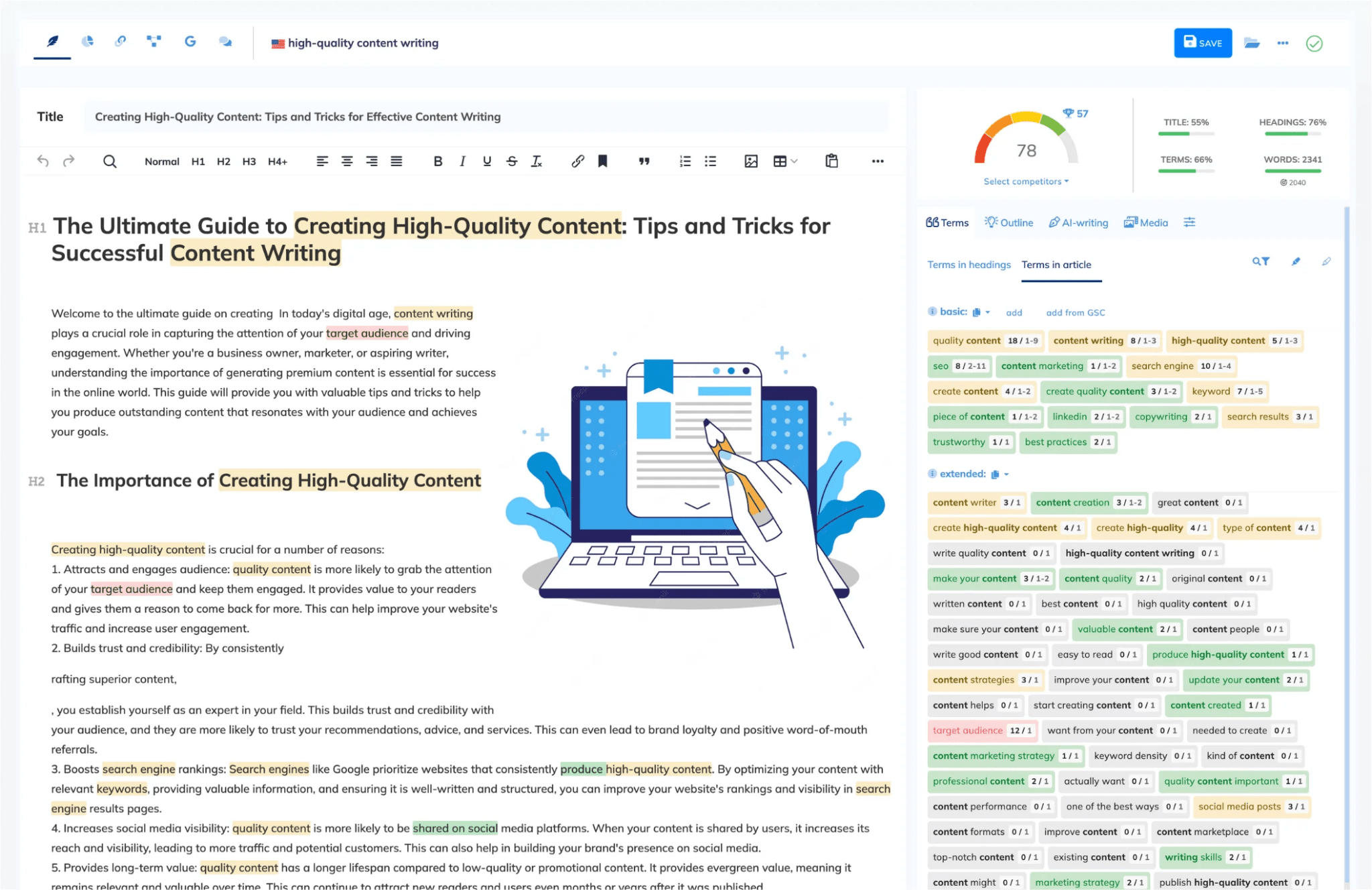
NeuronWriter is a budget-friendly AI SEO tools for small business platform that delivers high-level NLP optimization and content planning. It focuses on planning, writing, and optimizing content with user intent and machine-readability in mind. For 2026, its standout feature is the AI Score, a specialized GEO metric that evaluates how well an article covers the specific entities and facts that LLMs require to consider a source authoritative.
The platform identifies entities—specific people, concepts, and objects—that search engines and AI models use to categorize a page. By ensuring these entities are clearly defined and logically linked, NeuronWriter helps brands build a knowledge base that is frequently cited by AI assistants. It is widely regarded as the most cost-effective alternative to premium optimizers like Surfer SEO or Clearscope.
Pros of NeuronWriter
- Incredible Price-to-Value: Provides professional NLP optimization and content scoring at a fraction of the cost of its competitors.
- GEO AI Score: A dedicated 2026 metric for optimizing content for generative answer engines.
- Direct WordPress Export: Simplifies the publishing process by exporting optimized content directly to WP sites.
- Internal Link Suggestions: Uses AI to identify and recommend relevant internal linking opportunities to enhance site authority.
- Generative AI Templates: Includes templates for long-form articles, outlines, and summaries using the latest GPT models.
Cons of NeuronWriter
- Limited Technical Scope: Does not offer the backlink indexing or deep site audit features found in SE Ranking.
- Simplified Competitive Data: The SERP analysis is slightly less exhaustive than enterprise tools like Clearscope.
- Technical Dashboard: The interface is dense with metrics and may require some time for beginners to navigate comfortably.
Key Features of NeuronWriter
- Content Editor with AI Score: A real-time drafting environment that provides semantic entity recommendations and GEO readiness targets.
- Entity Extraction: Automatically identifies the key people, places, and concepts that must be covered to satisfy search algorithms.
- Topical Authority Planner: Helps users map out content clusters and find new topic ideas based on competitor gaps.
- Draft Generator: Builds outlines and initial drafts based on automated SERP analysis and entity suggestions.
Pricing Plans of NeuronWriter
NeuronWriter offers five tiers, making it accessible to users at every scale.
- Bronze Plan: $23/month. 2 projects, 25 analyses.
- Silver Plan: $45/month. 5 projects, 50 analyses.
- Gold Plan: $69/month. 10 projects, 75 analyses, and unlimited team members.
- Platinum Plan: $93/month. 25 projects, 100 analyses.
- Diamond Plan: $117/month. 50 projects, 150 analyses.
Final Verdict of NeuronWriter
NeuronWriter is the best free AI tools for SEO alternative for individual creators and SMBs who need professional-grade content optimization on a budget. It provides advanced NLP entity extraction and a unique GEO AI Score that even more expensive tools lack. While it isn’t an all-in-one SEO suite, its precision in content optimization makes it an essential component of any 2026 SEO stack.
10. Surfer SEO
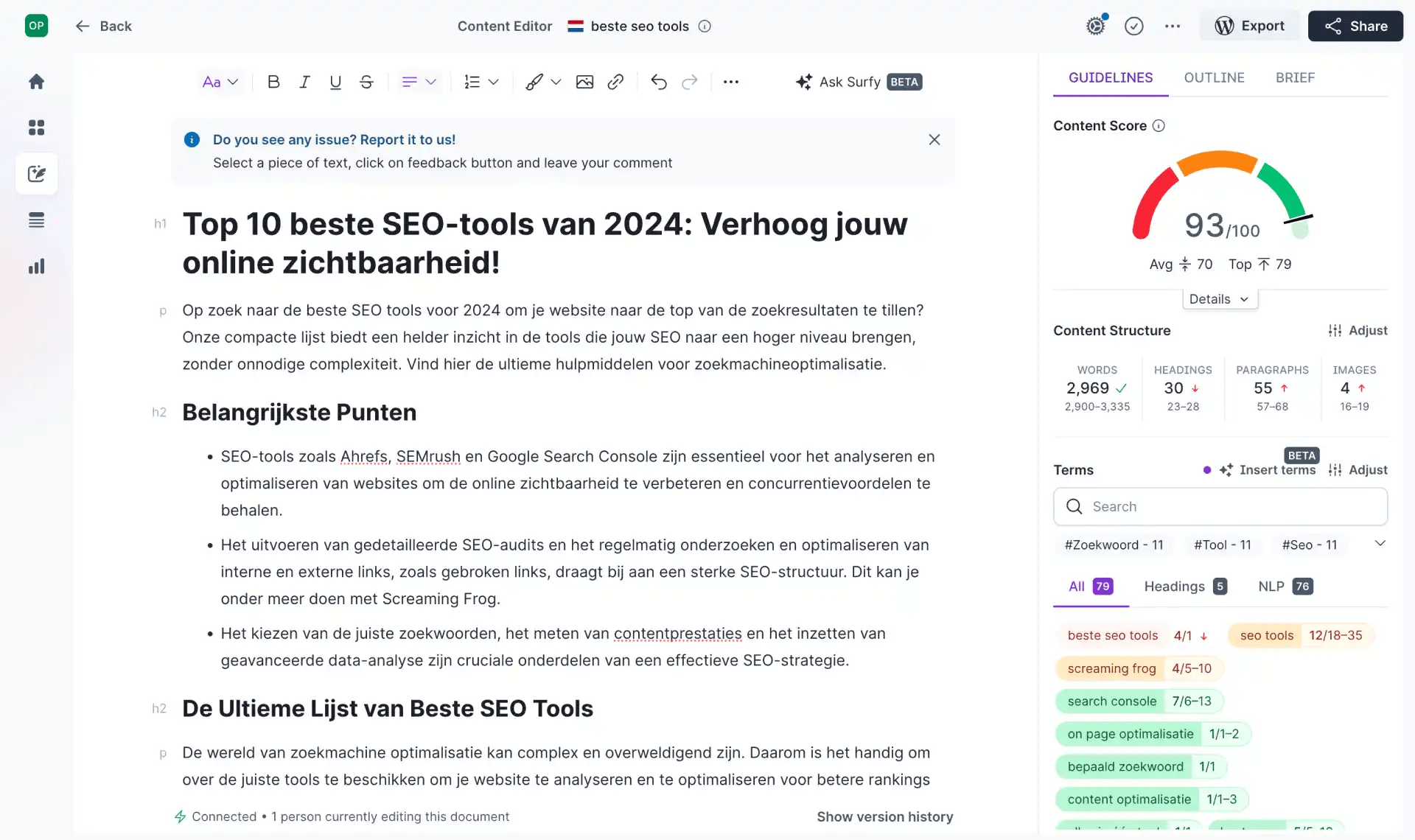
Surfer SEO is a specialized AI-based SEO tool that focuses on on-page optimization through Natural Language Processing (NLP). Instead of following outdated keyword density rules, Surfer analyzes the actual content structures of top-ranking competitors to calculate a Content Score. This score guides content creators on ideal word counts, heading hierarchies, and the specific semantic terms required to satisfy modern search algorithms.
By 2026, the platform has introduced an AI Tracker to monitor brand presence within generative results from ChatGPT, Perplexity, and Google AI Overviews. Surfer integrates natively with Google Docs, WordPress, and Jasper, allowing writers to optimize their articles as they draft them. This focus on the content-first strategy makes it a favorite among editorial teams and growth-focused agencies.
Pros of Surfer SEO
- Precision NLP Guidance: Provides a clear checklist of semantically related terms that increase the relevance of content for AI models.
- User-Friendly Scoring: The 0-100 Content Score provides an objective target for writers, ensuring consistency across large content teams.
- AI Search Visibility: The AI Tracker allows agencies to report on how often their clients’ brands appear in conversational AI summaries.
- Workflow Integration: Direct plugins for Google Docs and WordPress minimize friction between optimization and publishing.
- Topic Clustering: Automatically groups target keywords into topic clusters to help users build topical authority in their niche.
Cons of Surfer SEO
- Limited Technical Depth: Does not provide backlink indexing or technical site audit features found in all-in-one tools like SE Ranking.
- AI Content Repetition: Content generated by its Surfer AI module sometimes requires manual editing to ensure a natural flow and brand voice.
- No Credit Rollover: Monthly AI content generation credits do not carry over to the next month, which can lead to inefficient spending.
Key Features of Surfer SEO
- Content Editor: A real-time drafting environment that provides semantic term recommendations and formatting guidelines.
- AI Tracker: Monitors brand citations across ChatGPT, Perplexity, and AI Overviews with daily updates.
- Audit Tool: Compares existing pages against current SERP leaders to identify missing topics or excessive keyword usage.
- Keyword Research: Groups thousands of keywords into clusters to facilitate the creation of pillar pages and supporting articles.
- Jasper Integration: Enables the rapid generation of marketing copy that is pre-optimized for Surfer’s SEO standards.
Pricing Plans of Surfer SEO
Surfer SEO pricing is built around content volume and tracking requirements:
- Standard Plan: $119/month. Best for individual bloggers or single-site owners.
- Pro Plan: $219/month. Includes more content credits and is the starting point for small teams.
- Peace of Mind Plan: $359/month. For agencies requiring API access and higher volume tracking.
Final Verdict of Surfer SEO
Surfer SEO is the industry standard for on-page optimization. It is the best AI SEO tools choice for content agencies and editors who must ensure every published piece is mathematically optimized to rank. While it does not replace a technical suite like SE Ranking, its focus on semantic relevance is critical for building authority in the 2026 search environment.
Frequently Asked Questions about AI SEO Tools
What is the primary difference between AI SEO and Generative Engine Optimization (GEO)?
AI SEO generally refers to the use of AI-powered SEO tools to improve rankings in search engines that use machine learning, such as Google. Generative Engine Optimization (GEO) specifically targets conversational AI platforms and answer engines like ChatGPT, Gemini, and Perplexity. While AI SEO focuses on blue links, GEO ensures that a brand is cited and positively framed within AI-generated summaries.
Are keywords still relevant in a world of AI-driven search?
Keywords remain fundamental, but their role has shifted from exact-match phrases to search intent and entities. Modern AI tools for SEO emphasize topical clusters and the relationships between concepts rather than keyword density. A well-written 2026 guide explains a full topic comprehensively, ensuring that both traditional search engines and AI models understand the depth of the information.
Can AI-generated content rank effectively in 2026?
Yes, search engines prioritize helpful and authoritative content regardless of its origin. However, generic AI drafts that lack unique insights, proprietary data, or an expert perspective are unlikely to perform well. The best AI tools for SEO combine automated generation with human expertise to satisfy the requirements of E-E-A-T (Experience, Expertise, Authoritativeness, and Trustworthiness).
Why should agencies track brand visibility across multiple AI platforms?
Traditional SEO metrics do not account for the increasing volume of zero-click searches answered by AI chatbots. By using AI-powered SEO tools to track AI Share of Voice, agencies can prove their value in the discovery phase of the buyer journey, even if the user never clicks a traditional link.
How do AI SEO tools assist with technical optimization?
Platforms like Alli AI and Ahrefs use AI to detect and automatically fix common technical bottlenecks. These tools can generate schema markup, optimize meta tags, and manage internal linking at scale. This automation eliminates the implementation bottleneck where SEO strategies are stalled by limited developer resources.
Do I need an all-in-one platform or a specialized AI writer?
Most professional teams use an essential stack consisting of an all-in-one platform (like SE Ranking) for data and technical audits, a specialized content optimizer (like Surfer SEO), and an AI writing assistant (like Jasper). This combination ensures coverage across technical health, content quality, and production scale.
What are the main pitfalls to avoid when choosing an AI SEO tool?
Common pitfalls include chasing AI hype without a clear ROI and paying for features that your team does not actually use. It is also critical to verify whether optimizations are rented (vanish if the tool is canceled) or permanent. Always calculate the total cost of ownership, including additional seats and add-on modules.
How does E-E-A-T impact AI search results?
AI systems prioritize sources that demonstrate high Experience, Expertise, Authoritativeness, and Trustworthiness. Pages supported by original research, expert analysis, and authoritative backlinks are much more likely to be cited in AI-generated answers. Strong author profiles and consistent topical expertise are now essential for maintaining visibility in 2026.
Will generative search summaries reduce overall website traffic?
For simple informational queries, zero-click searches are increasing, which may reduce traffic to basic definition pages. However, being cited within an AI summary as an authority often increases brand trust and leads to higher-quality traffic for more complex, transactional queries. Monitoring these citations is now a core component of measuring SEO success.
How can small businesses start optimizing for AI search?
The most effective starting point is building a strong digital foundation using budget-friendly AI SEO tools for small business like SE Ranking or NeuronWriter. Focus on answering user questions directly and upfront, using structured data, and creating interconnected content clusters that demonstrate your unique expertise. This approach makes it easier for both humans and AI models to recognize your site as a trusted source.
Conclusion
The 2026 search landscape is defined by the transition from keyword matching to intent-driven authority. Selecting the best ai seo tools is no longer optional for agencies and in-house teams managing complex portfolios. These AI tools for SEO optimization facilitate the data-rich analysis required to capture visibility within both traditional SERPs and conversational AI interfaces. By integrating AI-powered SEO tools into professional workflows, marketers move from manual production to strategic oversight. The choice of platform determines a brand’s ability to remain discoverable, readable, and cited as a trusted source by the generative engines of the future.
